Key Takeaways
Latest Update on March 4, 2026
- Strategic Market Alignment: As of today, ˽·¿¾ãÀÖ²¿ has become a global financial standard used by over 700 institutional investors to manage and evaluate corporate risk.
- Pre-Compliance for Global Regulation: Reporting to the ˽·¿¾ãÀÖ²¿ serves as a critical "stress test" for mandatory regulations like CSRD and ISSB, ensuring company data is ready for rigorous legal scrutiny.
- Integrated Nature & Climate Scope: The 2026 cycle continues the shift toward a single, unified questionnaire covering Climate, Water, Forests, Plastics, and the newly introduced (unscored) Oceans module.
- The "Proof Gap" Challenge: The primary hurdle in ˽·¿¾ãÀÖ²¿ disclosure is data management, moving from "knowing" to "proving." Missing or unverified data points are one of the leading causes of point deductions and lower scores.�
- AI-Driven Efficiency: To combat reporting workloads, leading organizations are adopting AI and collaborative proof to cut manual effort by up to 50% while improving response quality and accuracy.
What Is ˽·¿¾ãÀÖ²¿ and Why Does It Matter?
The non-profit organization ˽·¿¾ãÀÖ²¿ (originally Carbon Disclosure Project) was founded in the UK in 2000 as a platform for companies to disclose their carbon footprint. Since then, the NGO has expanded its scope to include not only information on climate impact, but also on forests, water security, plastics, and biodiversity. ˽·¿¾ãÀÖ²¿ is a voluntary reporting system in which any company can participate, regardless of its size and sector.
The Strategic Value of Disclosure
˽·¿¾ãÀÖ²¿ disclosure is a critical business aspect that bridges the gap between financial success and ethical accountability.
- Market Influence: More than 700 institutional investors, managing over $142 trillion in assets, along with more than 330 large corporates use ˽·¿¾ãÀÖ²¿ data to drive investment and procurement decisions.
- Regulatory Readiness: Disclosure serves as a "pre-compliance" tool for mandatory global legislation, such as the EU Corporate Sustainability Reporting Directive (CSRD) and ISSB standards.
- Increased Transparency: By replacing vague claims with verified performance metrics, ˽·¿¾ãÀÖ²¿ holds businesses accountable for their impact on global resources.
More than 23,000 organizations, representing over two-thirds of global market capitalization, already use the standardized ˽·¿¾ãÀÖ²¿ questionnaire. This uniform system allows companies to benchmark their performance against peers, set science-based targets, and provide stakeholders with the data-driven evidence needed to secure a sustainable financial future.
How Does It Work? ˽·¿¾ãÀÖ²¿ Disclosure and Scoring
The ˽·¿¾ãÀÖ²¿ Process
The ˽·¿¾ãÀÖ²¿ process can be divided into three main steps:
- Reporting (Disclosure): Companies, cities, authorities, states, and regions are required to disclose their environmental impact.
- Insight: This information allows companies' performance to be compared with that of their competitors and evaluated by investors, cities, policymakers and other companies.
- Action: Based on these insights, ˽·¿¾ãÀÖ²¿ deploys campaigns to facilitate and drive meaningful action to tackle climate change.
With these three steps, ˽·¿¾ãÀÖ²¿ is pursuing its goal to motivate companies and cities to disclose environmental data, strengthen transparency and accountability for sustainable practices and promote a more sustainable future.
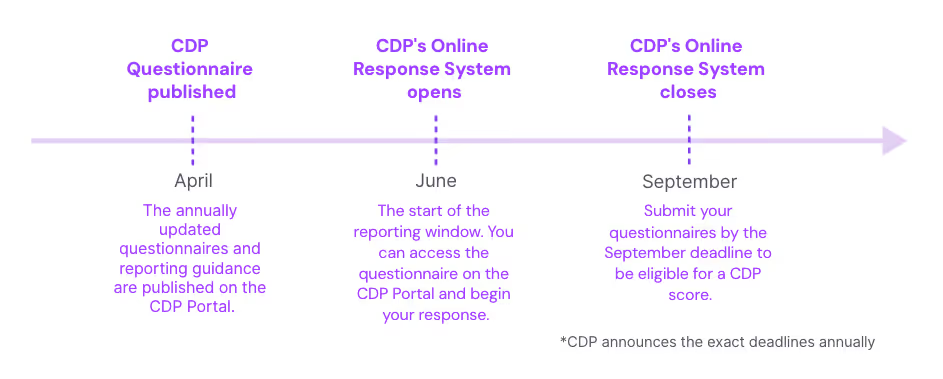
The ˽·¿¾ãÀÖ²¿ online portal opens every year in the second quarter. Even before the opening date, ˽·¿¾ãÀÖ²¿ recommends that companies start preparing their responses. For support, ˽·¿¾ãÀÖ²¿ provides helpful documents on its . In addition, working with a ˽·¿¾ãÀÖ²¿ Accredited Solutions Provider like Sunhat can facilitate the process considerably.Â
In order to receive a rating, completed questionnaires must be submitted by the week of September 14. Exact deadlines and further details are always announced via .
�
Companies that met the deadline receive a score from D- (lowest score) to A (highest score). The most successful companies are honoured by ˽·¿¾ãÀÖ²¿ through the release of the A-List to the public.
The 2026 Scoring Methodology: From D- to A
˽·¿¾ãÀÖ²¿ scores represent a company's journey from basic transparency to environmental leadership. ˽·¿¾ãÀÖ²¿ ratings provide a global benchmark for environmental accountability. They enable organizations to assess their sustainability progress and implement data-driven improvements.Â
This scoring system aligns corporate actions with international environmental targets and provides investors and stakeholders with a transparent, verified view of a company climate and nature-based strategies. To achieve the prestigious "A List," companies must demonstrate science-based targets and 1.5°C-aligned transition plans.
Focus Topics of the 2026 ˽·¿¾ãÀÖ²¿ Questionnaire
Every year, the ˽·¿¾ãÀÖ²¿ releases an updated version of its questionnaire. By updating the questionnaire annually, the ˽·¿¾ãÀÖ²¿ ensures that corporate disclosures remain transparent and current. This prevents "stale" disclosures and ensures alignment with the latest science-based targets. Preparing for these changes early is essential to avoid the last-minute scramble common in previous disclosure years.Â
The 2026 cycle continues the transition toward a single, integrated corporate questionnaire. This includes the mandatory modules for Climate Change, Water Security, and Forests (now including specific scoring for cocoa and rubber) and adding Oceans as a new category.Â
To receive a ˽·¿¾ãÀÖ²¿ rating in 2026, companies must disclose data on the specific environmental topics:
- Climate Change: Focuses on GHG emissions (Scopes 1, 2, and 3), 1.5°C transition plans, climate risks, opportunities, and governance.
- Water Security: Covers water consumption, withdrawal, discharge, risk mapping, and management across operations and supply chains.
- Forests: Focuses on deforestation risks, commodity traceability (timber, palm oil, soy, cattle), and sustainable land use.
- Biodiversity: Assessing dependencies on nature, impact on ecosystems, and alignment with the Global Biodiversity Framework.
- Plastics: A permanent section covering usage, recycling, and waste management across the value chain.
- Oceans (New for 2026): Introduction of ocean-related issues covering marine pollution and health.
The new Oceans module as well as Plastics and Biodiversity will be unscored in 2026, allowing companies time to prepare.Â
Overcoming Data Management Challenges
Keeping track of the annual changes and answering the ˽·¿¾ãÀÖ²¿ questionnaire is time-consuming and requires accurate and consistent data collection. The biggest challenge in ˽·¿¾ãÀÖ²¿ reporting for companies is data management, the ability to find, verify, and document the data points required for hundreds of questions. The process typically involves:
- Complex data collection from various departments ” from facility management to purchasing and production
- Complex data analysis, especially for COâ‚‚ balancing, including conversions and statistical evaluations
- Precise data preparation in accordance with the specific requirements of the ˽·¿¾ãÀÖ²¿ questionnaire
The requirements continue to become more demanding and extensive every year. Without a centralized system for collaborative proof, companies often struggle with data silos and version control issues, creating a Proof Gap: the space between knowing and proving. Ultimately, every missing or incomplete answer leads to a deduction of points in the final scoring. Efficient reporting in 2026 requires a continuous approach.
Using AI for Reporting Efficiency
Therefore, AI has become a critical tool for ESG managers to draft responses and map evidence to specific ˽·¿¾ãÀÖ²¿ questions. Teams can cut the manual effort of disclosure in half while increasing response quality and overall final rating score by using AI to analyze historical data, create an extensive answer library, and suggest improvements. However, human oversight remains essential for ensuring the accuracy of Proof.
Working with an Accredited Solutions Provider
˽·¿¾ãÀÖ²¿ partners with specialized technology providers to ensure that companies have the right tools to disclose accurately. Working with an accredited partner like ˽·¿¾ãÀÖ²¿ ensures that your data collection process is aligned with the latest ˽·¿¾ãÀÖ²¿ guidance and scoring methodologies.
Although AI optimizes the process, the œhuman-in-the-loop� remains the decisive factor for success. Experts critically review AI-generated templates and optimize them in a targeted manner. They ensure that evidence is efficiently compiled and securely validated by drawing on historical results and current benchmarking data. This allows for increasingly comprehensive disclosure requirements.
Guaranteed Expertise & Scoring Optimization
Accredited partners undergo rigorous training and auditing by ˽·¿¾ãÀÖ²¿ to ensure they are experts in the latest scoring methodologies.
- Previous Scoring Analysis: Experts can analyze your previous results and help to identify missing data or incorrect answers before you submit a new disclosure, significantly increasing your chances of moving from a D/C to a Leadership (A/A-) score.
- Current Guidance: Partners stay updated on annual questionnaire changes so your team always receives the support it needs to score a high ˽·¿¾ãÀÖ²¿ rating.
Conclusion: Turn ˽·¿¾ãÀÖ²¿ Disclosure into Your Advantage
In 2026, ˽·¿¾ãÀÖ²¿ reporting is a foundational element of corporate strategy. As global markets shift toward greater transparency, the ability to provide verified, high-quality environmental data has become a primary differentiator for attracting investment, securing supply chain partnerships, and meeting rigorous global regulations.
The journey from Disclosure (D) to Leadership (A) starts with mastering your data sustainably and effectively. Through collaborative data management and leveraging AI-driven tools, your organization can move past the manual burden of reporting and focus on what matters most: driving meaningful environmental action.
Whether you are disclosing for the first time or aiming for the prestigious A-List, the key to success in 2026 is early preparation and a œwrite once, read many� mindset. Nevertheless, it's important to understand that your company won't receive an A grade without demonstrating progress on its decarbonization pathway. Data is one part of it; demonstrating real action is the other.
Next Steps for Your ˽·¿¾ãÀÖ²¿ Cycle:
- Perform a Gap Analysis: Review your 2025 scores and identify exactly where gaps or problems in the last ˽·¿¾ãÀÖ²¿ disclosure appeared.
- Centralize Your Evidence: Move away from disconnected spreadsheets and into a unified "Source of Truth" for your ESG proofs.
- Engage Experts Early: Partner with an Accredited Solutions Provider like Sunhat to align your strategy with the latest 2026 scoring methodologies.
Frequently Asked Questions
The ˽·¿¾ãÀÖ²¿ Online Response System (ORS) typically opens for submissions in the second quarter (Q2) of 2026. To receive a scored rating, companies must submit their completed questionnaires by the mid-September deadline (usually the week of September 14th). We recommend beginning your data collection and "Proof Management" in Q1 to avoid the last-minute scramble.
˽·¿¾ãÀÖ²¿ has worked closely with EFRAG and the ISSB to ensure high levels of alignment. For 2026, the ˽·¿¾ãÀÖ²¿ questionnaire acts as a high-quality "trial run" for the Corporate Sustainability Reporting Directive (CSRD). By disclosing through ˽·¿¾ãÀÖ²¿, you are essentially organizing your data in a way that satisfies many of the European Sustainability Reporting Standards (ESRS), allowing for a "report once, disclose many" efficiency.
The most significant shift is the full integration of Nature and Biodiversity. While previously a pilot, biodiversity is now a core module. Additionally, 2026 sees the introduction of a new module for Oceans (covering marine health and pollution), which remains unscored for this cycle to allow companies to build their data maturity. There is also an increased focus on 1.5°C-aligned transition plans.
Moving to Leadership status requires moving from transparency to action. To secure an 'A' or 'A-', your company must demonstrate science-based targets (SBTi), verified Scope 1, 2, and 3 emissions, and a clear, board-level climate transition plan. Crucially, any gaps in "Proof"”the evidence behind your claims”result in point deductions, so centralized data management is essential. It's important to understand that your company won't receive an A grade without demonstrating real and ongoing progress on its decarbonization pathway.


Improve Your ˽·¿¾ãÀÖ²¿ Rating Effectively
Benefit of a simple checklist for clear planning, the right actions and valuable expert insights.



.avif)








.avif)